Next Gen Analog Compute at 250TOPS/W
Realizing the full potential of analog compute for Physical AI

We're enhancing our current analog compute technology with four key advances in the next-gen platform:
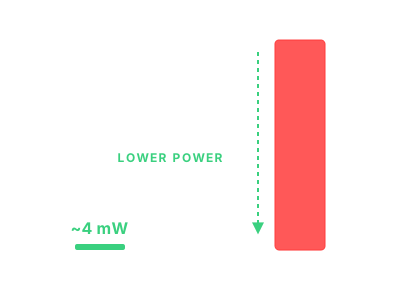
Even more Efficiency: Market-leading 250 TOPS/W
Analog compute in the transistor does the math where the weights are stored, removing the data movement that dominates power in digital AI. On an object-detection workload, the next-gen platform runs at about 4 mW, where a flagship mobile processor needs about 4 W: Blumind's technology delivers comparable performance at roughly 1,000× lower power.¹
¹ Compared with a leading incumbent low power MCU running YOLOv8n at 48 FPS.
Your lose the power but keep the flexibility and performance for your most demanding Physical AI applications
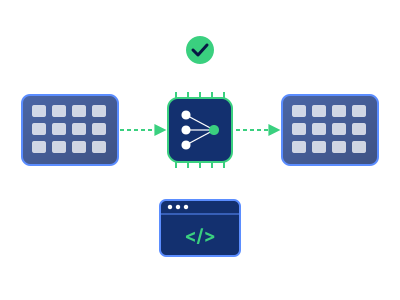
Ease of deployment: an end-to-end digital twin
Every network is modeled end-to-end in a digital twin of the analog silicon, so what you train is what runs on the chip. Teams keep their existing training flows and see the result before hardware arrives.
Our System-C model lets customers start system development and validation now.
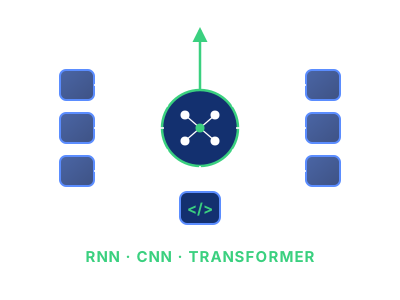
Smart flexibility: RNN, CNN and transformer
One flexible and programmable platform supports recurrent, convolutional and transformer networks, with broad coverage of tensor math functions. The same architecture can serve workloads from always-on audio to vision, speech recognition targeted speech extraction and small expert LLM models.
A heterogeneous compute fabric is being optimized to match each network type.
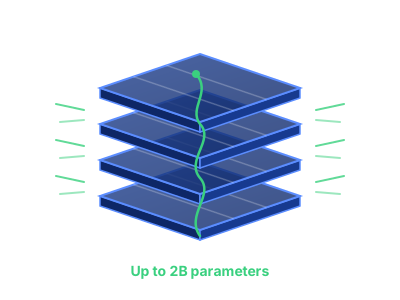
Stack compute, not memory: scale-up, not out
Blumind's analog compute runs so cool we can stack it high. Low heat dissipation lets compute dies stack on top of each other, adding capacity without growing the footprint or the thermal budget.
3D package stack-up scales to models of up to 2 billion parameters in a tiny footprint.
If you want to learn more about Blumind's next generation architecture contact us