BM110 · Always-on analog AI
Always listening. Barely powered.
Meet BM110
Why BM110?
Always-on AI without the battery penalty
Smart glasses, earbuds, watches and security sensors are expected to listen all the time. In most designs the always-on audio path keeps a digital microphone, an ADC and a processor awake, and battery life pays the price. BM110 moves that layer into analog compute, so the main system sleeps until there is a reason to wake up.
How it works
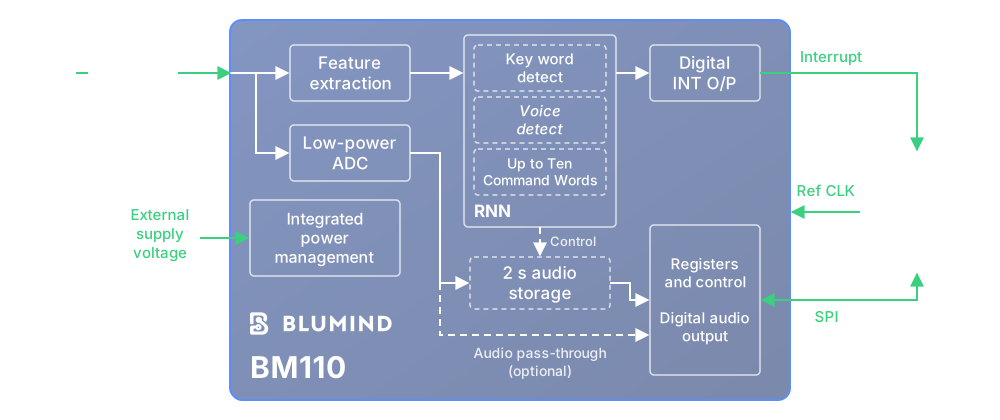
BM110 runs three neural networks at the same time. One binary network detects voice activity. A second binary network checks whether the voice contains a possible keyword. A multi-class network then identifies the specific wake word or command.
When BM110 detects voice, a wake word or a command, it sends a configurable interrupt to the host processor. With the audio buffer enabled, BM110 captures audio from the moment voice is detected, ahead of the wake word, and delivers it to the host as 16 kSPS digital audio over SPI. No part of the utterance is lost.
We compute in transistors at fJ-power levels per operation. We don't use high speed SRAM or clocks and we don't use precision voltage or current reverences for our compute. Our architecture is unique and disruptive, using device physics and smart ratio-metric design to deliver the lowest possible power without the typical analog compute compromises.
~50 µA for the complete always-on audio system
- Voice, wake word and command detection: ~30 µA (typ.)
- Analog microphone: ~20 µA (typ.)
- Optional 2-second audio buffer: ~8 µA (typ.)
That is the full always-on audio front end, microphone included, for about 50 µA. The result is dramatically longer battery life in smart watches, smart glasses, earbuds and security sensors.
Product Highlights
Key features
- Highly integrated AI audio inference ASSP
- Always-on voice, wake word and command detection at ~30 µA (typ.)
- Detects voice, a wake word and up to 10 commands
- Optional integrated 2-second audio buffer (~8 µA typ.)
- Three simultaneous recurrent neural networks (RNNs)
- 350K programmable, field-updatable parameters
- All-analog signal path for direct analog sensor input and lower system power
- Fully autonomous audio detection
- System MCU stays in deep sleep until an event is detected
- Interrupt-driven MCU interface
- High-speed SPI for communication and data transfer
- Driver support for standard MCUs
- Microphone pass-through, digital output mode
- Blumind AMPL™ compute engine: robust, stable and reliable across process, voltage, temperature and lifetime drift
- Ideal for cost-, space-, power- and thermally constrained applications
- Integrated power management
- 16-ball WLCSP, approx. 2.25 mm × 2 mm, 0.5 mm ball pitch
- Commercial and industrial operating ranges supported
- Suitable for time-series data applications beyond audio
Tiny 16-ball WLCSP
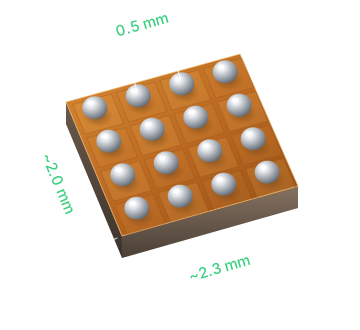
BM110: ~2 mm × 2.3 mm
- Small size: fits the tightest designs, such as smart glasses, earbuds and watches.
- Simple PCB design: works on standard 4-layer PCBs, with no micro-vias needed.
- Cost-effective: a chip-scale package with no substrate, on a lower-cost board.
Software
Train your model in PyTorch or TensorFlow. The Blumind translator maps the quantized, compressed coefficients into a weights file for BM110. Weights load at power-up and are stored in the compute fabric but can be updated in the field as your product evolves.
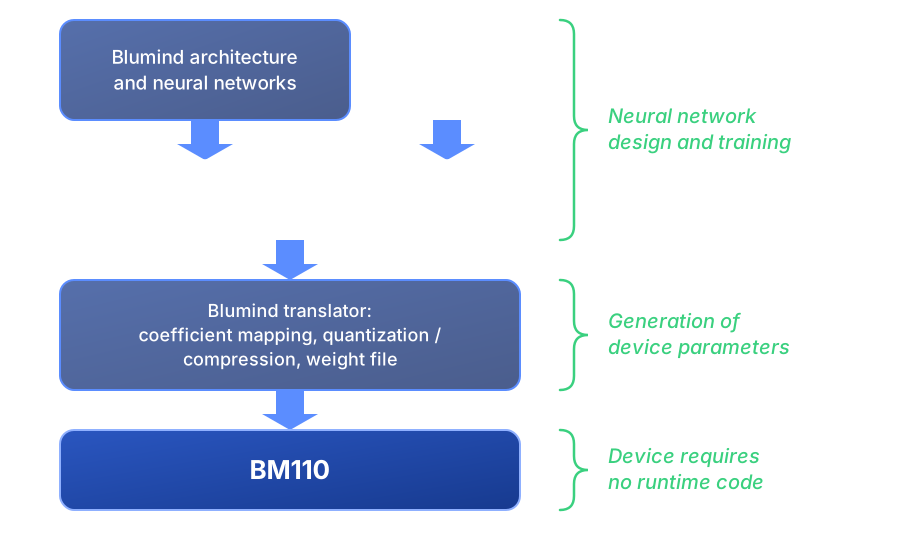
When we develop our ML models and test our silicon we always compare our analog compute network performance against a digital equivalent network running on a processor or FPGA.
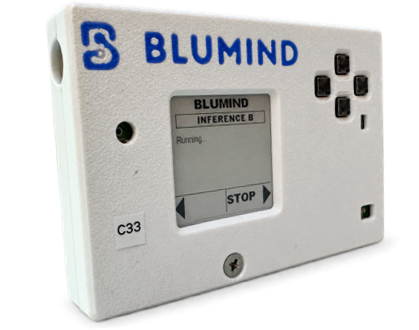
BM110 evaluation kit
Evaluate BM110 in your own audio environment.
If you are a well qualified customer working on high volume consumer or industrial applications contact us to learn more.